
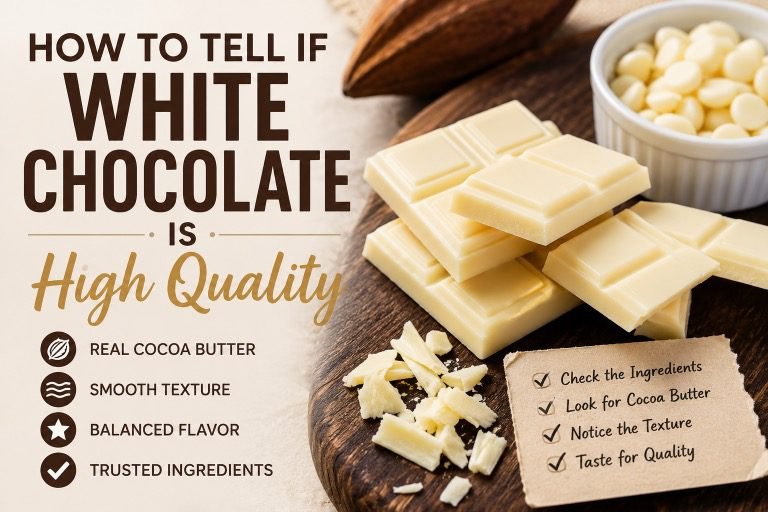
White chocolate is one of the most misunderstood treats in the chocolate world.
Some people dismiss it as “too sweet.” Others say it’s not even real chocolate. And many have only ever tasted low-quality versions that left a waxy film on their tongue.
But when white chocolate is made properly — with real cocoa butter, balanced sweetness, and careful craftsmanship — it can be silky, aromatic, and genuinely luxurious.
So how do you tell the difference?
How can you spot high-quality white chocolate before you even take a bite?
Let’s break it down clearly and honestly — so the next time you’re shopping or baking, you know exactly what to look for.
What Makes White Chocolate Different From Other Chocolate?
Before we judge quality, we need to understand composition.
White chocolate contains:
- Cocoa butter
- Sugar
- Milk solids
- Sometimes vanilla
- A small amount of emulsifier (like lecithin)
What it does not contain: cocoa solids.
That’s why it’s ivory-colored instead of brown and why its flavor is creamy rather than cocoa-forward.
If you want a full breakdown of how white chocolate is legally defined, you can read our guide on what white chocolate is and how it’s made.
In the United States, the FDA requires white chocolate to contain at least:
- 20% cocoa butter
- 14% milk solids
- 3.5% milk fat
Anything labeled “white baking chips” that replaces cocoa butter with vegetable oils? That’s not true white chocolate.
And this is where quality begins.
How to Tell If White Chocolate Is High Quality
Let’s get practical.
There are six key things to check — some before buying, some after tasting.
1. Check the Ingredient List (This Is the Most Important Step)
If you only remember one thing from this article, remember this:
Real cocoa butter should be listed.
High-quality white chocolate will list:
- Cocoa butter
- Sugar
- Milk solids
- Vanilla
Low-quality versions often list:
- Palm kernel oil
- Vegetable oil
- Hydrogenated fats
Those substitutes change everything:
- Texture becomes waxy
- Flavor becomes flat
- Melt becomes greasy
The shorter and cleaner the ingredient list, the better.
2. Look at the Color
High-quality white chocolate is not bright white.
It should be:
- Ivory
- Cream-colored
- Slightly warm-toned
If it’s pure, paper-white, that’s often a sign of heavy processing or fat substitutes.
Real cocoa butter has a soft yellow tint.
3. Listen for the Snap
Just like dark chocolate, good white chocolate should have a clean snap when broken.
It won’t be as sharp as 70% dark chocolate, but it should not bend or crumble.
If it feels soft at room temperature, it may contain too much added fat.
If you’re curious about why chocolate melts and snaps the way it does, you might enjoy our article on Why hocolate melts in your hands but not in the box.
Tempering matters.
4. Pay Attention to the Melt
High-quality white chocolate should:
- Melt smoothly
- Coat your tongue gently
- Leave a creamy finish
Low-quality white chocolate often:
- Feels waxy
- Leaves a greasy residue
- Tastes overly sugary
The difference is immediate if you taste them side by side.
5. Evaluate the Flavor Balance
Good white chocolate is sweet — but not one-dimensional.
It should have:
- Gentle dairy notes
- Natural vanilla aroma
- Slight buttery richness
It should not taste like:
- Straight sugar
- Artificial vanilla
- Candy coating
If it makes your teeth ache from sweetness, it’s likely lower quality.
6. Consider the Brand Transparency
High-end chocolate makers often specify:
- Cocoa butter percentage
- Origin of ingredients
- Ethical sourcing
Organizations like the National Confectioners Association provide industry standards that reputable brands follow.
Transparency usually signals care.
Common Mistakes People Make When Buying White Chocolate
1. Confusing “White Baking Chips” with White Chocolate
Many grocery store chips are made with vegetable oil, not cocoa butter.
They’re designed to hold shape, not melt luxuriously.
2. Choosing the Cheapest Option
White chocolate quality varies more dramatically than dark chocolate quality.
A small price increase often means a major flavor improvement.
3. Storing It Incorrectly
Even high-quality white chocolate can bloom or discolor if stored poorly.
Keep it in a cool, dry place (60–70°F).
Avoid humidity and sunlight.
For full storage guidance, see:
How to store chocolate to keep it fresh – tips from experts
Is Expensive White Chocolate Always Better?
Not necessarily.
Price can reflect:
- Branding
- Packaging
- Import costs
But not always ingredient quality.
Just as we discuss in are expensive chocolates really better?
The ingredient list tells you more than the price tag.
When High-Quality White Chocolate Truly Shines
White chocolate performs beautifully in certain applications.
Baking
It melts evenly and adds creamy sweetness.
For example, it transforms cookies like these
Decorative Drizzles
It contrasts beautifully over dark desserts.
Holiday Treats
Peppermint bark and festive desserts benefit from its creamy base — like in:
White chocolate Christmas cracks
In these cases, quality makes a visible and flavorful difference.
Is High-Quality White Chocolate Healthier?
White chocolate does not contain cocoa solids, which are associated with certain antioxidant compounds found in dark chocolate (Harvard T.H. Chan School of Public Health).
It primarily contains:
- Sugar
- Cocoa butter (fat)
- Milk solids
So while high-quality white chocolate tastes better, it’s not a health food.
Moderation matters.
People Also Ask About White Chocolate Quality
Why does some white chocolate taste waxy?
Because it uses vegetable fat instead of cocoa butter.
Should white chocolate be pure white?
No — ivory or cream tones are better signs of quality.
Why does white chocolate burn easily?
Milk solids caramelize quickly, so it requires gentle heat.
If you’re melting it, follow our guide on how to melt chocolate chips easily.
How long does white chocolate last?
Properly stored, about 6–12 months. Flavor declines over time.
FAQ
How can I tell if white chocolate is fake?
Check for cocoa butter in the ingredients. If it lists palm kernel oil instead, it’s not true white chocolate.
Is premium white chocolate worth it for baking?
Yes. It melts better and improves flavor depth.
Does high-quality white chocolate contain caffeine?
No. Caffeine comes from cocoa solids, which white chocolate does not contain.
Why is my white chocolate grainy?
It may have seized due to moisture or overheated during melting.
The Takeaway: How to Tell If White Chocolate Is High Quality
High-quality white chocolate isn’t about flashy packaging.
It’s about:
- Real cocoa butter
- Balanced sweetness
- Creamy melt
- Clean ingredient list
- Proper storage
When made well, white chocolate is smooth, aromatic, and comforting.
When made poorly, it’s waxy and overly sweet.
The difference comes down to ingredients, craftsmanship, and attention to detail.
Next time you’re standing in the chocolate aisle, will you flip the bar over and check the label first?
Our Authority Sources
To ensure accuracy and current information (2026), we referenced:
- U.S. Food & Drug Administration (FDA)
Defines legal standards for white chocolate composition. - Harvard T.H. Chan School of Public Health – Nutrition Source
Evidence-based nutrition research. - Cleveland Clinic – Health Essentials
Guidance on chocolate and moderation. - Academy of Nutrition and Dietetics
Balanced dietary insights. - National Confectioners Association
Chocolate production and quality standards.