
Chocolate is one of life’s simplest pleasures. But if you’ve ever flipped a chocolate bar over to check the nutrition label, you’ve probably paused at one number in particular: sugar.
That pause usually leads to a familiar question:
Is milk chocolate really that much higher in sugar than dark chocolate?
The short answer is yes—but the why, the how much, and the what it means for you are where things get interesting.
In this guide, we’re breaking down sugar content in milk vs dark chocolate in a clear, practical way. No scare tactics. No guilt. Just honest information to help you choose the chocolate that fits your taste, your habits, and your everyday life.
Why Sugar Matters in Chocolate (But Isn’t the Whole Story)
Sugar plays an important role in chocolate. It:
- Balances bitterness from cocoa
- Affects texture and melt
- Makes chocolate widely enjoyable
The problem isn’t sugar itself—it’s how much, how often, and what it replaces in the chocolate.
Understanding sugar content helps you:
- Compare chocolate types realistically
- Avoid misleading labels
- Enjoy chocolate with more intention
Milk Chocolate vs Dark Chocolate: The Big Picture
At a glance, the difference seems simple:
- Milk chocolate = sweeter
- Dark chocolate = less sweet
But the sugar gap isn’t just about taste. It comes down to ingredients and proportions.
Milk Chocolate Basics
Milk chocolate typically contains:
- Cocoa solids
- Cocoa butter
- Milk powder or condensed milk
- More added sugar
Because milk softens bitterness, manufacturers rely on sugar to build flavor.
Dark Chocolate Basics
Dark chocolate usually contains:
- Higher cocoa solids
- Cocoa butter
- Less added sugar
- No milk solids (in most cases)
This is why dark chocolate tastes more intense—and why sugar content drops as cocoa percentage rises.
For a broader foundation on chocolate types, Milk Chocolate vs Dark Chocolate Nutrition walks through these differences beyond sugar alone.
Sugar Content in Milk vs Dark Chocolate: Real Numbers
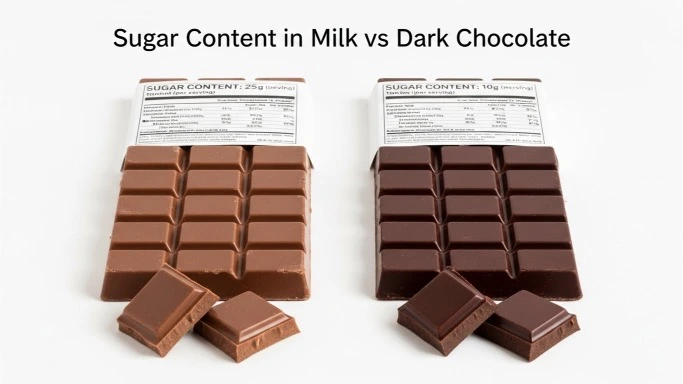
Let’s look at typical ranges per 1 oz (28g) serving. Exact numbers vary by brand, but these averages give a realistic picture.
Milk Chocolate (Typical)
- Sugar: 14–18 grams
- Cocoa percentage: ~30–40%
Dark Chocolate (70–85% Cocoa)
- Sugar: 5–9 grams
- Cocoa percentage: 70–85%
That’s often half the sugar—or less in dark chocolate compared to milk chocolate.
According to FDA, the Daily Value for added sugar is 50g (based on a 2,000-calorie diet). One milk chocolate bar can take up a large chunk of that—quickly.
Why Cocoa Percentage Changes Sugar So Much
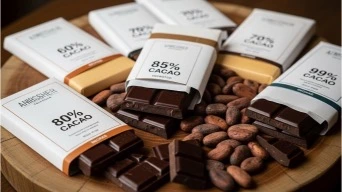
Cocoa percentage tells you how much of the bar comes from:
- Cocoa solids
- Cocoa butter
As cocoa percentage goes up:
- Sugar goes down
- Bitterness increases
- Flavor becomes more complex
That’s why a 90% dark chocolate bar may taste sharp but contain very little sugar, while a creamy milk chocolate bar tastes mild but carries much more sweetness.
This also affects how chocolate behaves in recipes. If you bake, Regular Chocolate vs Baking Chocolate – All You Need to Know explains how sugar impacts structure and balance.
Does Less Sugar Automatically Mean “Healthier”?
Not automatically—but it can matter.
Lower sugar chocolate may:
- Reduce blood sugar spikes
- Feel more satisfying in smaller portions
- Highlight cocoa flavor over sweetness
According to Harvard T.H. Chan School of Public Health, many potential benefits associated with chocolate come from cocoa compounds—not sugar.
That’s why darker chocolate is often discussed in health contexts.
If you want a deeper dive into cocoa’s role, Dark Chocolate Benefits for Women explores this connection without turning chocolate into a health myth.
Taste Matters: Why Some People Prefer Milk Chocolate
Sugar content isn’t everything.
Milk chocolate:
- Feels nostalgic
- Tastes smoother and creamier
- Appeals to a wider range of palates
For some people, dark chocolate’s bitterness reduces enjoyment—and enjoyment matters. Chocolate you don’t enjoy won’t fit sustainably into your routine.
That’s why the best chocolate choice is one you’ll enjoy without overdoing it.
Sugar and Portion Size: The Overlooked Factor
One important truth:
Most people eat more milk chocolate at once and less dark chocolate.
That means:
- A small piece of dark chocolate may satisfy
- Milk chocolate often invites larger portions
So sugar intake depends on:
- Chocolate type
- Portion size
- Eating habits
This perspective aligns with our article Reasons Why Chocolate Is Bad for You , which explains how moderation—not chocolate itself—is the real issue.
What About “Low Sugar” or “Sugar-Free” Chocolate?
Labels can be misleading.
Reduced-Sugar Chocolate
- Often still sweet
- May use sugar alcohols or alternative sweeteners
Sugar-Free Chocolate
- Uses substitutes like stevia, erythritol, or maltitol
- Can cause digestive discomfort for some people
If you’re exploring these options, read our article Best Sugar-Free Chocolate: How to Choose the Healthiest Chocs that offers a clear, label-focused guide.
Milk vs Dark Chocolate in Everyday Situations

For Snacking
- Dark chocolate helps control sugar intake
- Milk chocolate feels more indulgent
For Desserts
- Milk chocolate blends smoothly into sweet recipes
- Dark chocolate adds contrast and depth
For Drinks
- Milk chocolate makes creamier hot chocolate
- Dark chocolate offers richer cocoa flavor
If drinks are your thing, Is Hot Chocolate Good for Health? The Truth About Your Cup explains how sugar content changes depending on preparation.
Common Sugar Myths About Chocolate
“Dark chocolate has no sugar”
False. It has less, not none.
“Milk chocolate is always unhealthy”
Not true. It depends on portion size and frequency.
“Cocoa percentage tells the whole story”
Helpful—but always check the label.
People Also Ask: Sugar Content in Milk vs Dark Chocolate
Does dark chocolate always have less sugar?
Yes, when cocoa percentage is higher.
Is milk chocolate bad because of sugar?
Not inherently—overconsumption is the issue.
How much sugar is too much?
That depends on your total daily intake.
Can I eat chocolate daily?
Yes, if portions and sugar are reasonable.
Which chocolate has the least sugar?
High-percentage dark chocolate (85–90%).
Is 70% dark chocolate low sugar?
Lower than milk chocolate, but not sugar-free.
Does white chocolate have sugar?
Yes—often more than milk chocolate.
Should kids eat dark chocolate instead?
In small amounts, but taste preference matters.
How to Choose the Right Chocolate for You
Instead of asking “Which chocolate is better?”, try asking:
- How much sugar am I already consuming today?
- Do I want sweetness or cocoa depth right now?
- Will a small portion satisfy me?
There’s room for both milk and dark chocolate in a balanced life.
Final Thoughts: It’s About Awareness, Not Restriction
Understanding sugar content in milk vs dark chocolate isn’t about cutting chocolate out. It’s about enjoying it with clarity.
Milk chocolate:
- Sweeter
- Comforting
- Higher in sugar
Dark chocolate:
- More intense
- Lower in sugar
- Often more satisfying in smaller amounts
Neither is “wrong.”
The best choice is the one you enjoy—without losing sight of balance.
And if you enjoy chocolate explained honestly, without guilt or exaggeration, you’ll always find thoughtful guides like this on ChocoTalks.com, where chocolate is meant to be savored, not judged.
Our Authority Sources
- FDA – Added Sugar & Nutrition Labels
Explains daily sugar limits and food labeling standards. - Harvard T.H. Chan School of Public Health – Chocolate & Cocoa Compounds
Research-backed insights into cocoa flavanols and nutrition. - Cleveland Clinic – Dark Chocolate & Health
Medical perspective on sugar, cocoa, and moderation. - International Cocoa Organization – Cocoa Composition
Global context on cocoa processing and chocolate structure.